| |
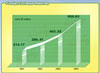
Money Supply By the end of 2004, the money supply of broad sense (M2) was 25.3 trillion yuan, reflecting a year-on-year increase of 14.6 percent. The money supply of narrow sense (M1) was 9.6 trillion yuan, up 13.6 percent. Cash in circulation (M0) was 2.1 trillion yuan, up 8.7 percent. The balance of savings deposits in RMB and in foreign currencies in all financial institutions totaled 25.3 trillion yuan at the end of 2004, up 15.3 percent as compared with the year-end figure of 2003. The outstanding loans in RMB and in foreign currencies by all financial institutions reached 18.9 trillion yuan, up 14.4 percent.
 Increasing Loans The outstanding loans in RMB by rural credit cooperatives stood at 1.9 trillion yuan at the end of the year, an increase of 253.2 billion yuan over the end of 2003. The consumption loans in RMB by all financial institutions totaled 2 trillion yuan, an increase of 432.7 billion yuan, of which, the loans for housing to individuals were 1.6 trillion yuan, an increase of 407.3 billion yuan. Increasing Loans The outstanding loans in RMB by rural credit cooperatives stood at 1.9 trillion yuan at the end of the year, an increase of 253.2 billion yuan over the end of 2003. The consumption loans in RMB by all financial institutions totaled 2 trillion yuan, an increase of 432.7 billion yuan, of which, the loans for housing to individuals were 1.6 trillion yuan, an increase of 407.3 billion yuan.
Stock Market In 2004, funds raised through stock issue and rights
issue on stock market totaled 151.1 billion yuan, an increase of 15.3
billion yuan over the previous year. Of this total, the A-share market
witnessed 123 stock issues (including additional issues and convertible
bonds) and 23 rights issues, with 83.6 billion yuan of capital paid in,
an increase of 1.6 billion yuan over 2003. The issue of 28 B and H shares
raised 67.5 billion yuan worth of foreign capital, an increase of 13.7
billion yuan. The number of listed companies (with A or B shares) on Chinese
mainland stock market rose from 1,287 at the end of 2003 to 1,377 at the
end of 2004, with market capitalization of 3.71 trillion yuan, a shrink
of 12.7 percent from the previous year.
Insurance Sector In 2004, the premium of domestic and foreign insurance companies totaled 431.8 billion yuan, up 11.3 percent over the previous year. Of this total, the premium of life insurance was 285.1 billion yuan, that of health and accident insurance was 37.7 billion yuan, and that of property insurance was 109 billion yuan. The insurance companies paid an indemnity of 100.4 billion yuan, of which, the indemnity of life insurance was 30.8 billion yuan, and that of health and accident insurance was 12.9 billion yuan. Another 56.8 billion yuan was paid as reparations in property insurance programs.
 In line with the timetable committed by China at its entry into the WTO on December 11, 2001, China's insurance industry has gradually removed restrictions on foreign-funded insurance companies in terms of geographical location and business scope. Starting from December 11, 2003, foreign-funded non-life insurance companies in China have been allowed to provide local customers with a range of non-life insurance services, and they have also been permitted to set up wholly owned subsidiaries in China. One year later, China's insurance industry was fully opened to foreign insurers in terms of geographical locations. Meanwhile, foreign-funded life insurance companies were allowed to provide Chinese citizens with health insurance, group insurance and pension insurance services. Statistics show that by the end of 2003, 39 foreign insurance companies had set up 70 business branches in China. In line with the timetable committed by China at its entry into the WTO on December 11, 2001, China's insurance industry has gradually removed restrictions on foreign-funded insurance companies in terms of geographical location and business scope. Starting from December 11, 2003, foreign-funded non-life insurance companies in China have been allowed to provide local customers with a range of non-life insurance services, and they have also been permitted to set up wholly owned subsidiaries in China. One year later, China's insurance industry was fully opened to foreign insurers in terms of geographical locations. Meanwhile, foreign-funded life insurance companies were allowed to provide Chinese citizens with health insurance, group insurance and pension insurance services. Statistics show that by the end of 2003, 39 foreign insurance companies had set up 70 business branches in China.
Banking Industry Opened Wider By the end of October 2004,
a total of 62 foreign banks of 19 countries and regions had set up 204
business institutions, with 105 of them permitted to engage in RMB business.
Since December 12, 2003, when foreign banks were first allowed to provide
Chinese enterprises with RMB service, 61 foreign banks have been permitted
to conduct this business. In 2004, 24 foreign banks acquired permission
to run financial derivative business, 13 foreign banks were allowed to
offer online banking service in China, and five branches of foreign banks
were allowed to open QFII (qualified foreign institutional investor) trust
business. Besides business institutions, foreign banking institutions
have opened 223 representative offices in China. By the end of October
2004, assets of foreign banks in China had totaled US$65.9 billion, accounting
for about 1.8 percent of the total assets of China's banking institutions,
and their outstanding loans stood at US$31.5 billion, with a 1.3 percent
bad debt rate. Between January and October 2004, foreign banks in China
yielded a total of US$2.1 billion in profits. Nine Chinese commercial banks
have so far been allowed to have foreign investors acquire their stakes.
The China Banking Regulatory Commission (CBRC) approved two foreign automobile
financial companies to open business in China and another two to make
preparations for starting business.
On December 1, 2004, foreign financial institutions were allowed to engage in RMB business in five more cities--Kunming, Beijing, Xiamen, Xi'an and Shenyang, thus increasing the number of such cities from 13 to 18. Prior to this, foreign financial institutions had been allowed to handle RMB business in Shanghai, Shenzhen, Tianjin, Dalian, Guangzhou, Zhuhai, Qingdao, Nanjing, Wuhan, Jinan, Fuzhou, Chengdu and Chongqing.
Starting from January 1, 2005, foreign banks are allowed to provide an insurance agency service to approved clientele within their approved business scope after reporting to local CBRC branches.
|
|