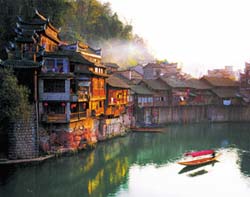
The sound of a floor being swept broke the silence of dawn. I woke up early at a cozy hostel in Fenghuang, a small township in western Hunan Province and home of the Miao minority group.
Feeling refreshed, I poked my head out the window to find that the mist hovering over the town was clearing off. The air was fresh and mixed with a sweet smell of ginger candy, since the town abounds with these candy workshops.
Later, I took a stroll along the slab stone streets and reached the bank of the Tuojiang River that meanders through the town. Red sandstone castle walls with watchtowers and iron gates stood on the bank and slim wooden boats were docked at the ferry near the castle wall.
Standing beside the river, the memory of yesterday's boat tour emerged.
Along with some excited tourists, I drifted along the peaceful and crystal-clean river. As we floated downstream, from time to time we heard ethnic songs sung by Miao girls, dressed in their ethnic costumes. Everyone on the boat was moved by the local people's hospitality.
Our imaginations were also captured by wooden houses with extended floor spaces built above the river. This diaojiaolou (hanging attic) is a style typical of the Miao. The foundations of the houses look precarious, but they have remained steady and safe for decades.
While I was immersed in memory, the sound of an Erhu, a Chinese bowed-string instrument, shifted my attention to a young man who played discreetly near the ferry. It seemed of if he was narrating the small township's history with a solemn tune.
Fenghuang's history dates back 1,316 years. Archaeologists believe it was a military camp. The majority of its inhabitants were soldiers who were sent to quell Miao riots.
Gradually, the Miao, who had originally lived in caves, moved to the city and lived with soldiers. They began building wooden dwellings. Most of the wooden buildings there now were constructed during the late Qing Dynasty (1644-1911).
The small township is also known as the home to several celebrated Chinese writers and artists. Among them is Shen Congwen, a modern writer whose work, Chinese Ancient Costume Research, is the most authoritative on the subject, and the traditional Chinese painter Huang Yongyu.
The young man did not stop playing his instrument, though an increasing number of people were passing by. The sun shattered the mist away, and the town became brisk again with throngs of people, such as elderly vendors, souvenir sellers and travelers. Ginger candy shops began making their specialty and owners switched on speakers to proclaim that their products were superior to their competitors.
Traveling tips
Lodging: Staying at a local residence costs 20-40 yuan per person per night, with a 10 yuan surcharge for air conditioning.
Food: Dishes are hot and spicy. Eating out in Fenghuang is cheap. A full day of meals costs about 20 to 30 yuan per person, and the cuisine includes a wide scope of local delicacies.
Local crafts: Batik printed clothes and paintings, silver and ox bone ornaments.
(Shenzhen Daily November 18, 2003)
|