TV must bear social responsibility
- By Gong Wen
 0 Comment(s)
 Print
Print E-mail
China.org.cn, November 2, 2011
E-mail
China.org.cn, November 2, 2011


 |
|
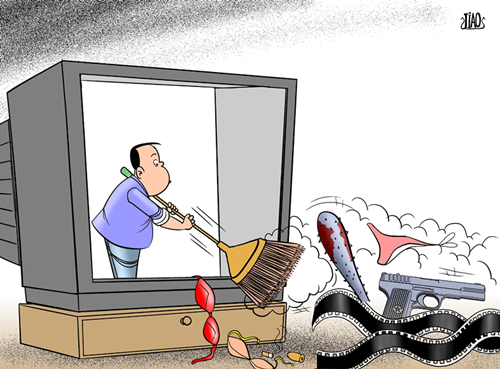
The State Administration of Radio, Film and Television (SARFT) announced in a directive that it will limit entertainment and add more programs that "build morality and promote the core values of socialism." [By Jiao Haiyang/China.org.cn] |
Despite some negative reactions of netizens to recent entertainment regulations introduced by the State Administration of Radio, Film and Television (SARFT), over half of the Chinese netizens, according to surveys done by two leading portal websites, sohu.com and ifeng.com, approve of the new regulation issued on Oct. 25 aiming at reining in "excessive entertainment" and "poor taste" of TV shows.
The regulation, nicknamed the "entertainment limit rules", state that only two entertainment programs are allowed to be shown on each of the country's 34 satellite channels during prime time. Figures show that Chinese audiences are not satisfied with Chinese television stations, especially satellite television networks, which fail to air social programming.
Sixty-four years ago, after four years of research, the Hutchins Commission concluded in its report A Free and Responsible Press that "the press plays an important role in the development and stability of modern society and, as such, it is imperative that a commitment of social responsibility be imposed on mass media". Since then, in spite of technological advancement, it is generally accepted that the media should adhere to certain moral obligations.
Walter Lippmann once pointed out in his Public Opinion that people actually live in a pseudo-environment shaped by mass media. In this sense, satellite television stations in China are exerting great influence on younger generations. However, they have been neglecting their social responsibility to cultivate a sense of morality in today's youth. Instead, they attach priority to audience ratings and profits.
As pointed out by the SARFT legislation, some TV stations have "tried to attract audiences through low-taste content such as gossip and invasion of privacy. Doing so not only wastes resources but also does nothing to improve the quality of TV programs."
Examples of the types of shows identified as counterproductive to society in SARFT are everywhere. Money-worshipping, vulgarity, and indecency fill Chinese screens.
Professor Shao Peiren of Zhejiang University, a senior scholar in the field of journalism and communication, posted on his Weibo that "the media of news is becoming entertainment, serious media is becoming careless, righteous media is turning snobbish and the pioneering media are becoming followers." Shao's remarks are a vivid description of the current situation of Chinese satellite televisions dominated by economic interests.
Lack of creativity and innovation is another problem facing Chinese satellite television. Most satellite televisions are either imitating other Chinese television stations or overseas counterparts, leading to grave homogenization of satellite TV programs. When you turn on TV at night, you'll likely find that one third of channels are occupied by TV dating shows while the third are sensationalized, with the rest advertisements. Severe competition caused by program homogenization has led to more vulgar ways to attract eyeballs, leaving social responsibility behind.
The new regulations may not be enough to balance different functions of media as well as the relationship between profit and social responsibility. In addition, limiting programming may not be the best way to change Chinese television. However, the legislation sets the correct tone for the direction the country's media should be taking.
Gong Wen is a visiting scholar at the School of Journalism and Communication at Tsinghua University.
Opinion articles reflect the views of their authors, not necessarily those of China.org.cn.


Go to Forum >>0 Comment(s)