Trumpian trade wars
- By Sumantra Maitra
 0 Comment(s)
 Print
Print E-mail China.org.cn, November 25, 2016


|
|
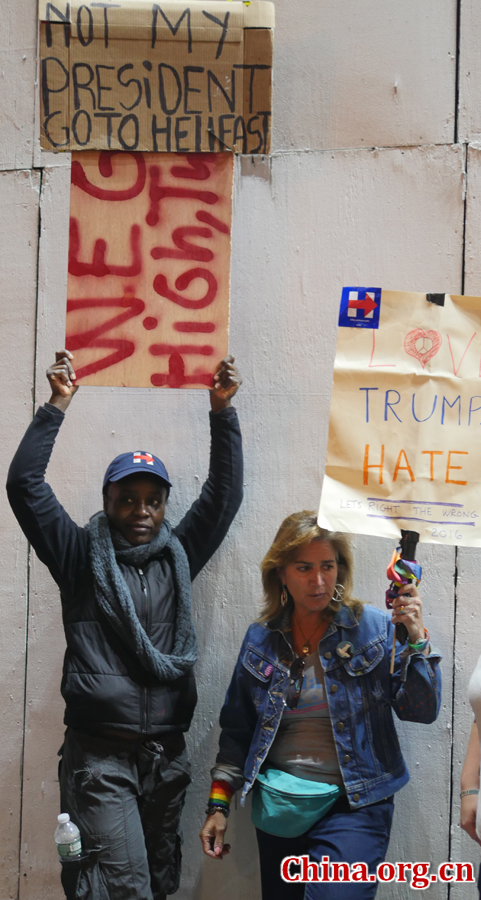
| Two protestors outside Trump Tower hold signs reading "Love Trumps Hate" and "Not my president – Go to hell fast". [Photo by Kyle Calandra/China.org.cn] |
As we all know during the election campaign, now U.S. President-elect Donald Trump had accused China of unfair trade practices and currency manipulation, claiming that it puts the U.S. at an unfair trading disadvantage with regards to China. He also threatened to slap a 45 percent import tariff on Chinese products, although just like many of his policies, he later denied having said that completely. Questions now arise as to how a realistic trade war would look like, if it is at all feasible and if it so happens what will be the implications on global macroeconomics.
I recently took part in a discussion and simulation on the issue. As agreed there, China is not regarded as a currency manipulator anymore. Recently, as I have wrote here often, after the RMB was designated as one of the reserve currencies by the IMF, even the U.S. has stopped calling Chinese currency undervalued. Not that this matters to an economic nationalist, and Trump, as U.S. president, will theoretically have enough power to chart U.S. trade policies. If, as per election rhetoric, Trump actually applies a 45 percent tariff, the results will be significant and Chinese exports to the U.S. will fall by over 50 percent. Obviously, it is incredible that China will accept this hands down.
A primary method of Chinese retaliation would be to file a case in the WTO, but that might result in even more potential hurtful blowbacks. An op-ed in the Global Times on the eve of Trump's win suggests that China might in retaliation cancel and replace orders of Boeing with Airbus; and put tariffs on U.S. cars, phones, and food products like soybeans and maize. On the face of it, these threats seem counterproductive, but they make sense if one goes deeper and calculates how much American products such as the iPhone are dependent on Chinese markets, and how much U.S. companies will suffer from losing Chinese markets.
Here's the interesting thing, at this point, it is all speculation and it is highly unlikely that there will be a trade war between China and U.S. Let me explain why. Over the last couple of decades, the center of production across the world has moved eastwards. There are several reasons for this, but primarily, due to Chinese/Indian labor cost competitive advantages. Over the last twenty years, simultaneously, American and Western citizens have had an extremely high minimum wage resulting in production bases of companies based in America shifting to China. There's a simple example of this economic reciprocation. 75 percent of the parts of an iPhone are made in China, which is why the cost of the iPhone is affordable across the U.S. Otherwise, if the production was located in the U.S., the iPhone wouldn't be affordable for the middle class.
The idea that is propagated by Trump, and his supposed chief advisor Bannon, is one of economic nationalism. It is not something new, the idea of an autarkic self-sufficient economy. The U.S. has experienced it before in 1928. It resulted in the Great depression. The Soviet Union was the last autarky. It collapsed because it didn’t follow the basic rule of the economy, ceteris paribus, of demand and supply and competitive advantages.
Fortunately, Trump is a businessman. As the same article of Global Times point outs, Trump is knowledgeable of the basics of business and knows he cannot turn back time. The idea of pristine lily white, coal mining, manufacturing giants of 1950s America is good in theory, but is practically impossible to achieve. If Trump forces American companies to manufacture at home, and they end up losing gigantic markets abroad, whatever basic operations they have stateside, they will close it down, and move to places like Hong Kong or Mumbai. Trump, despite his bluster, knows that. His supporters don’t.
Secondly, Trump's cabinet picks thus far provides hints that he will have a traditional Republican administration, and will have a foreign policy focus on Islamic terrorism. It can of course change, but by definition that means, Trump’s administration would basically like to cut a deal with other great powers like Russia and China and have a transactional and realpolitik relationship. That's a hopeful thing, and might lead to better relations with China and Russia, which is overall not such a bad thing for the world.
Sumantra Maitra is a columnist with China.org.cn. For more information please visit:
http://www.china.org.cn/opinion/SumantraMaitra.htm
Opinion articles reflect the views of their authors only, not necessarily those of China.org.cn.


Go to Forum >>0 Comment(s)