|
|
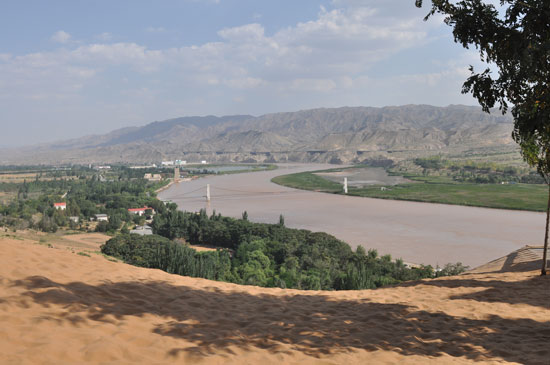
China turned its desert into a fruit growing oasis in Ningxia Hui Autonomous Region. [Photo by Wang Zhiyong/China.org.cn]
|
Innovative solutions spearheaded by a province in China, have turned its fortunes around, thanks to irrigation and tree planting in the desert area.
For a province that has vast tracts of desert land and is ranked third in development among China's five autonomous provinces, Ningxia Hui Autonomous Region, located in northwest China, has registered remarkable progress. Statistics from China's premier website www.china.org.cn indicate that Ningxia is the province with the third smallest GDP in China, with its neighbours, Inner Mongolia and Shaanxi, classified as the strongest emerging provincial economies in that country. And yet for a casual Ugandan visitor, Ningxia's capital, Yinchuan, would be one of the most developed and well planned metropolises with very good road network- compared to Kampala, of course.
As a largely arid region, Ningxia's transformation is mainly attributed to the province being China's principle supplier of wolfberries— a fruit this region regards a treasure, accounting for 42 per cent of the entire nation's total wolfberry production. At the Research Institute of Lycium Barbarum in Yinchuan, there are large plantations of wolfberries and grapes, grown mainly for medicinal purposes and producing wine.
Mr Wang Ling of Ningxia's Department of Agriculture, Forestry and Animal Husbandry, says the region's development path is hugely determined by agriculture.
"The Yellow River (for irrigation purposes) is very important for us, for our plants and for our animals," says Ling, adding that the achievements they have so far made would not have been possible without sustained anti-desertification campaigns such as tree planting.
One such project is a paper industry base whose raw materials come from a vast tree-planting scheme in a desert area in Zhongwei City. Started in 2001, the Meili Group that manages this project has been able, in the last 11 years, to turn large portions of this former desert into an expansive Greenland, supported by constant irrigation from the Yellow River.


