|
|
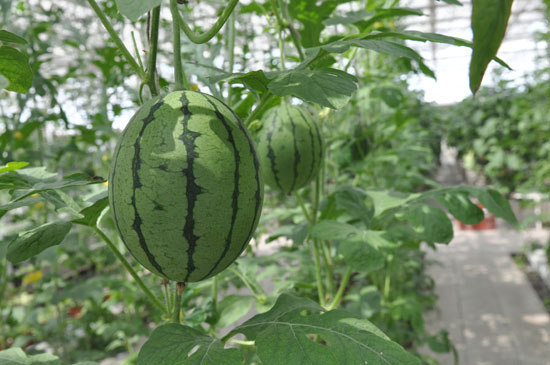
China turned its desert into a fruit growing oasis in Ningxia Hui Autonomous Region. [Photo by Wang Zhiyong/China.org.cn]
|
Replanting the desert
While the trees have worked wonders for the environment, it also supplies, upon maturity, raw materials for the paper industry. Organic materials from the same paper industry are in turn used to fertilise the tree plantations. It is, according to Wang Ting, Deputy General Manager of Meili Forestry Developing Company, a-win-win situation. "The forests revive the environment and supply raw materials; the paper industry provides fertilisers," he says.
This is by no means an easy venture. Though the land was given by government, with some subsidies and loans extended to the group, it takes a lot of work and dedication to carry out a project of this magnitude, moreover in a desert. There still remain significant challenges: Inadequate water for irrigation, sand storms, insects and pests. The overall goal of eventually turning this desert into oasis, however, overrides these challenges. Already, the project has improved the local environment and, according to Mr Ting, if they can encourage more locals to plant trees, this will positively impact the environment as well as improve the economic conditions of the people. This forestry development venture is a classic case of a region that is not, like Uganda, gifted by nature, but has devised ways of making good use of their desert land. On the contrary, in Uganda where we are naturally rich in vegetation, our environment management practices are quite poor. According to projections, Uganda could lose its forest cover in less than 40 years if action is not taken to reverse poor environment management. A 2008 Environment Report warned of the dire consequences of forest cover degradation, especially disappearance of wetlands and water bodies. Four years later, Uganda's state of the environment remains poor, if not worse.
Innovative solutions
Ningxia, on the other hand, has used innovative ways to develop their agricultural output and supply of dairy products (dairy farms depend mainly on corn that is planted on a large scale partly because they want to preserve their grassland from being destroyed by grazing cattle). According to Mr Kang Zhanping, the Deputy Director General of the Publicity Department and Director of External Publicity Office, Ningxia Hui Autonomous Region, wolfberries are not Ningxia's only competitive edge. The region's agriculture success lies primarily in the ancient irrigational system from the famous Yellow River.
The Helan Horticulture Industry Park, for instance, produces a rich variety of crops using hydroponics method- a process where plants are grown without soil and necessary food elements mixed with the water used for irrigation. Through this method, officials at this industrial park say they are able to produce a wide variety of crops in large quantities on limited space. That is why Ningxia is able to export vegetables and fruits to mainly Hong Kong among other countries as well as sweet potatoes to the Middle East and other Arab countries.
This agricultural development can be partly attributed to the region's agriculture academy that carries out research in agriculture technologies for development of crops such as wheat, corn, rice as well as fruits like the famous wolfberries.


