 Share:

CCTV:
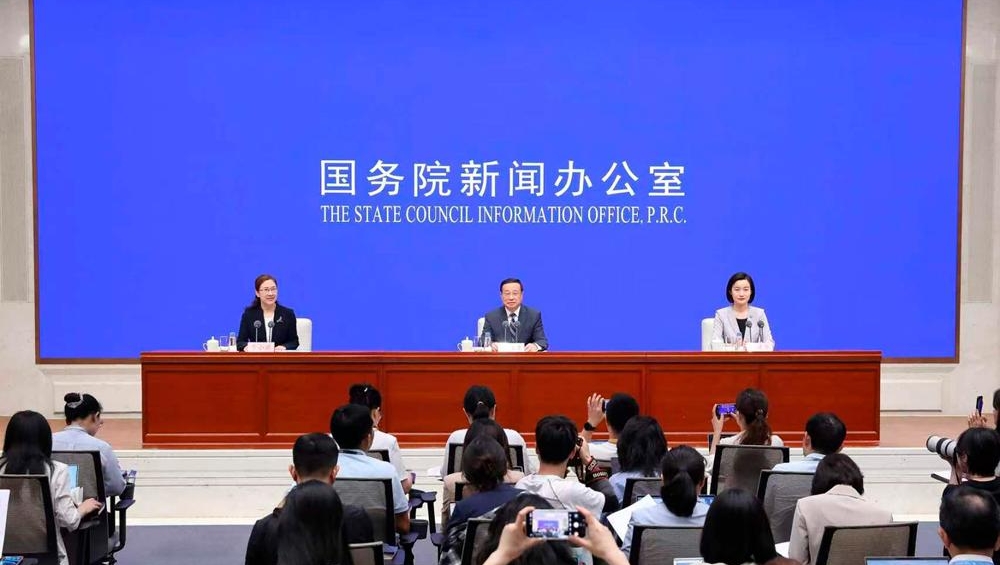
Despite external uncertainties in the first half of this year, China's economy maintained steady growth. How would you evaluate the overall performance of the economy in the first half of the year, and what were the highlights and positive changes? Thank you.
Mao Shengyong:
Thank you. Since the beginning of this year, the external environment has been turbulent, and some new situations and old problems have been intertwined and superimposed domestically. Faced with a complex situation, under the strong leadership of the CPC Central Committee with Comrade Xi Jinping at its core, all regions and government departments have taken proactive steps and implemented comprehensive policies. They have implemented more proactive and impactful macro policies in a precise and effective manner, developed new quality productive forces in accordance with local conditions, and effectively responded to external shocks and challenges. China's economy has withstood pressure and maintained a generally stable and positive development trend, demonstrating strong resilience and vitality. Judging from the general situation, it can be summarized in four aspects: "stability", "resilience", "innovation-driven" and "high-quality."
The first is "stability." The economy has operated smoothly overall, with major indicators remaining within an appropriate range. In terms of growth, China's GDP reached 69.6 trillion yuan in the first half of this year, a year-on-year increase of 4.7% at constant prices, which is in line with the expected economic growth target for the whole year. Compared with the first half of last year, GDP increased by 3.6 trillion yuan, marking the largest increase for the same period in the past five years. For an economy as large as China, achieving a growth rate of 4.7% is truly remarkable. Although the growth rate slowed down in the second quarter, the fundamentals of stable economic operation and the trend towards innovation-driven and high-quality development have not changed. Since the beginning of this year, especially since the second quarter, the world economy has seen new changes. Some international institutions predicted that the growth rates of major economies would decline to varying degrees in the second quarter. For example, the growth rate of the United States was expected to fall from 2.7% in the first quarter to 2.1%, Japan's growth rate was expected to fall from 0.4% in the first quarter to 0.2%, and the Eurozone's growth rate was expected to be around 0.5%. The International Monetary Fund (IMF) recently lowered its forecast for global economic growth this year to 3.0%, down from 3.5% last year. However, the forecast for China's full-year economic growth was raised by 0.2 percentage point. In terms of employment, the average urban surveyed unemployment rate was 5.2%, the same as the same period last year, and down 0.1 percentage point from the first quarter. In terms of prices, the CPI rose moderately, increasing by 1.0% year on year, while the core CPI rose by 1.2%, maintaining an overall level above 1% in the first half of this year. The PPI has turned from negative to positive, rising by 1.5% in the first half of this year, compared with a decline of 0.6% in the first quarter. The CPI rose by 1% year on year in the first half of the year. Both prices were within the appropriate range of 1%-2%, and the overall price performance was relatively ideal, with a moderate upward trend. This is not easy. Inflationary pressures are rising sharply in most economies around the world, and the IMF has recently raised its full-year global inflation forecast to 4.7%. Under these circumstances, China's prices have remained stable. In terms of the balance of payments, the scale of goods trade reached a new high, foreign exchange reserves remained stable at over US$3.4 trillion, and the RMB exchange rate has appreciated by about 3% since the beginning of this year. From the perspective of comprehensive macroeconomic indicators, China's overall macroeconomy is stable, with major indicators operating within an appropriate range. This is what we mean by "stability."
The second is "resilience." China's economic development has continued to demonstrate resilience, effectively responding to external risks and challenges. In terms of energy supply security, since March, the geopolitical conflict in the Middle East has severely impacted the global energy supply. China has been focusing on both domestic production and diversified imports. In the first half of the year, domestic production of crude oil, natural gas, and electricity all reached record highs for the same period. Crude oil production by industrial enterprises above designated size increased by 0.9% year on year, natural gas by 1.6%, and electricity generation by 3.5%. Production of major energy products remained stable, imports were self-supporting and risk-controllable, and energy supply was sufficient to meet various energy needs for production and daily life. From the perspective of market prices, rising energy prices have led to increased global inflationary pressures, and the IMF has raised its global inflation forecast for this year to 4.7%. In contrast, China's policies to ensure supply and stabilize prices have been forceful and effective, and the price control mechanism for refined oil products has been promptly implemented, resulting in a moderate increase in the CPI with little fluctuation. From the perspective of food security, the summer grain output exceeded 300 billion jin for the first time this year, further consolidating the foundation of food security and laying a solid foundation for grain production, price stability, and people's livelihood support throughout the year. Looking at foreign trade, global trade growth has slowed down, but China's imports and exports have shown strong resilience. In the first half of the year, the total value of goods imports and exports reached 25.5 trillion yuan, of which exports increased by 13.4% and imports increased by 22.1%. In the first quarter, China's share of global foreign trade increased by about 0.8 percentage point compared to the same period of the previous year. Despite the complex and ever-changing external environment, the resilience of the Chinese economy has been remarkably strong.
The third word is "innovation-driven." The pace of innovation-driven and high-quality development is steadily accelerating, with new growth drivers contributing over 40% to the overall growth. New growth drivers include not only high-tech industries, modern services, and digital industries, representing the growth of industries in new technologies and areas, but also traditional industries achieving green transformation and upgrading through digitalization. Preliminary estimates indicate that in the first half of this year, new growth drivers, represented by high-end manufacturing, the digital economy, and modern services, contributed over 40% to the economy's growth. China's economy is moving toward innovative and high-quality development, and the overall development trend is accelerating. For example, in the first half of the year, the added value of high-tech manufacturing enterprises above designated size increased by 13.3% year on year, among which the added value of aerospace vehicle and equipment manufacturing and electronic and communication equipment manufacturing industries increased by 16.3% and 17% respectively, while industries related to artificial intelligence such as integrated circuit manufacturing and intelligent vehicle equipment manufacturing maintained robust growth rates of over 30%. The green transformation continued to gain momentum, as the retail penetration rate of new energy vehicles surpassed 60% for three consecutive months in the first half of the year, contributing to a 39.3% increase in lithium-ion battery production. In recent years, the transition from traditional growth drivers to new ones has accelerated, with new growth drivers expanding steadily and playing an increasingly prominent role in driving China's economic growth.
The fourth word is "high-quality." With improvements in quality and efficiency, the economy has achieved substantial growth. First, the share of manufacturing has remained stable and increased. Manufacturing remains the cornerstone and a key strength of China's economy. In the first half of this year, the added value of the manufacturing sector accounted for 26.2% of GDP, up 0.4 percentage point from the same period three years ago. Second, corporate profits and business expectations have improved. From January to May, the profits of industrial enterprises above the designated size increased by 18.8% year on year, maintaining double-digit growth since the beginning of the year. In particular, industries related to new growth drivers, such as electronics and non-ferrous metals, have outperformed in terms of profitability. In June, the manufacturing PMI stood at 50.3% and the Business Activity Index for Services reached 50.4%, up 0.3 and 0.1 percentage point respectively, from the previous month. This indicates that market expectations remain stable. Third, energy consumption intensity has decreased. Industrial structure optimization and ongoing improvements in energy-saving technologies, as well as the green and low-carbon transition have driven a steady decline in energy consumption. Preliminary estimates indicate that energy consumption per unit of GDP declined by 1.9% year on year in the first half of the year.
Considering the above factors, the current international environment remains complex and volatile, with global economic growth generally slowing, international trade also losing momentum, and inflationary pressures rising significantly in many countries. Against this backdrop, China's economy maintained a growth rate of 4.7% in the first half of this year, while prices saw a modest growth, employment was generally stable, the balance of payments continued to improve, and new growth drivers in emerging fields accelerated their expansion. Chinese economy has improved the quality of growth and appropriately increased output. Thank you.


 京公网安备 11010802027341号