Share:

Zhejiang Daily Tide News:
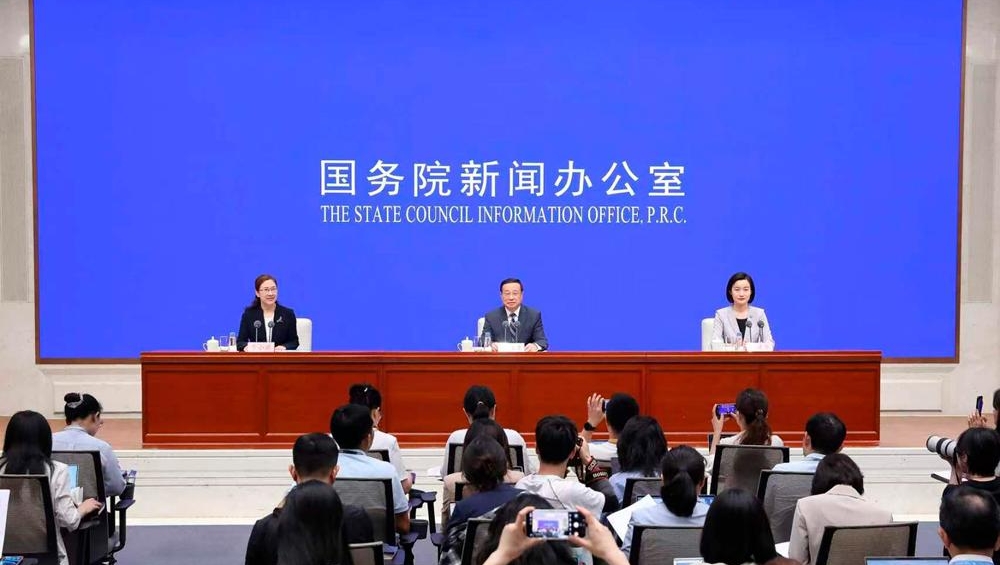
You mentioned that high-tech manufacturing industries, such as those related to AI and high-end equipment manufacturing, posted strong performance in the first half of the year, providing fresh impetus for economic growth. What are the highlights of the development of new growth drivers this year? Thank you.
Mao Shengyong:
Ms. Wang will take this question.
Wang Guanhua:
Thank you for your question. In the first half of the year, China's transition from old to new growth drivers gathered pace, with many highlights in technological and industrial innovation. These advancements have been tangible in people's daily work and lives. For example, intelligent production lines and industrial robots have become commonplace in factories, while new energy vehicles (NEVs) and smart home appliances have become popular in people's daily lives. These emerging industries, new products and new forms of demand are building new strengths for high-quality development and providing solid support for China's economy to maintain stable performance while continuing to improve. Let me give you some details.
First, a number of technology-intensive and highly resilient emerging industries have provided strong support. After years of planning and development, China's emerging industries have gradually grown stronger and gained momentum. In the first half of the year, the added value of high-tech manufacturing above designated size and digital product manufacturing increased by 13.3% and 12.3%, respectively, with both growth rates accelerating from the first quarter. In particular, the surge in demand for high-end computing chips and memory chips brought about by the global AI technological revolution led to a 23.1% increase in the output of integrated circuits from China's industrial enterprises above designated size in the first half of the year, reaching 279.8 billion units. This is a huge number, equivalent to an average daily production of more than 1.5 billion integrated circuits. Integrated circuits, commonly known as chips, are widely used in intelligent equipment and electronic products. The daily output of more than 1.5 billion chips is not merely a change in the numbers, but a vivid reflection of the driving force behind the development of China's semiconductor industry. In addition to integrated circuits, the output of intelligent products such as 5G smartphones, 3D printing devices and service robots has also maintained rapid growth. Daily token usage has reached hundreds of trillions, marking a leap to a new level of scale and demonstrating the vitality and potential of the country's digital economy and intelligent economy. We have also made preliminary calculations on the industrial sector. In the first half of the year, new growth drivers, represented by high-tech manufacturing and digital product manufacturing, contributed nearly half of industrial growth with a value-added share of over 20%, making them an important engine for driving industrial growth. The transformation and upgrading of the manufacturing industry have also driven demand for professional services such as information technology, modern finance, R&D and design, and business services, opening up broad prospects for growth in the modern service sector. In the first half of the year, both the information transmission, software and information technology services sector and the leasing and business services sector recorded growth rates of over 10% in value added, contributing nearly one-quarter to the country's overall economic growth.
Second, a number of new products in line with the trend toward green and low-carbon development have gained rapid growth. Thanks to its complete industrial chain and continuous technological advancement, China's competitive advantages in fields such as new energy, new materials, and green equipment are becoming increasingly evident, giving rise to new source of economic growth. For example, the development of clean energy has boosted the output of nuclear power generating units and hydroelectric generating units by 92.0% and 51.9%, respectively. Increased demand for NEVs and energy storage led to a 39.3% increase in lithium-ion battery production. Traditional industries such as petrochemicals and chemical fibers have also seen the emergence of high-performing green sub-sectors. The added value of the petroleum processing industry above designated size increased by 1.9%, while the biomass fuel processing industry increased by 33.0%. Likewise, the traditional chemical fiber industry increased by 3.4%, while the bio-based materials manufacturing industry increased by 21.9%. This demonstrates that new growth drivers are not only found in emerging and future industries. Traditional industries can also unleash new growth momentum through transformation, upgrading and digitalization, and regain new vitality and dynamism.
Third, new demands arising from industrial upgrading and quality consumption are being released at a faster pace. Industrial development is driven by demand. At present, new features and trends are emerging in both investment and consumption. In terms of investment, enterprises are placing greater emphasis on R&D innovation and continuing to increase investment in areas such as patent, software and databases. In the first half of the year, investment in intellectual property products accounted for 13.8% of fixed asset investment, up 1.4 percentage points from the first quarter. On the consumption side, smart, green and health-related consumption is gradually becoming a new consumption trend. Since the beginning of the year, the implementation of the consumer goods trade-in policy has been improved, with smart glasses becoming eligible for subsidies. In the first half of the year, retail sales of wearable smart devices, including smart glasses, increased by more than 100%, while that of energy-efficient home appliances increased by more than 30%. The "performance plus consumption" model, featuring concerts, music festivals and sporting events, continues to gain popularity, better meeting people's demand for high-quality cultural experiences and immersive experiences.
Fourth, a number of innovative and dynamic new enterprises that are deeply involved in niche markets are emerging. Enterprises play a principal role in innovation, and the foundation for fostering new quality productive forces also lies in enterprises. In recent years, a number of innovative and enterprising high-quality enterprises have emerged in various industries, of which "little giant" enterprises that use specialized and sophisticated technologies to produce unique and novel products are a typical representative. Currently, there are more than 17,600 national-level "little giant" enterprises, mostly distributed in key links of the industrial chain. A batch of "little giant" enterprises, by concentrating on niche markets and continuously overcoming technical obstacles, have sharpened their distinctive competitive edge. In doing so, they have not only effectively made up for the weak links in the industrial chain, but also injected new momentum into economic development. In the first half of the year, the added value of these "little giant" enterprises above designated size increased by 10.4% year on year. Another noteworthy statistic is that in late June, the World Economic Forum released its latest list of "lighthouse factories," with half of the 16 newly added global lighthouse factories coming from China. Lighthouse factories represent the global benchmark for the digital and intelligent transformation of manufacturing. Currently, China ranks first in the world for the number of lighthouse factories, demonstrating the remarkable achievements of AI and digital technology in empowering the transformation of manufacturing.
The transformation from old to new growth drivers is a systematic project that cannot be accomplished overnight. It requires sustained efforts and long-term commitment. In the next stage, we must adhere to the principle of seeking progress while maintaining stability and adopting measures tailored to local conditions. We should continue to focus on cultivating and expanding emerging and future-oriented industries and transforming and upgrading traditional industries to promote a smooth transition between old and new growth drivers. Thank you.


 京公网安备 11010802027341号